
People don’t think of Bon Jovi as a diplomatic organization. But playing the Moscow Music Peace Festival with Ozzy Osbourne, the Scorpions, Mötley Crüe, Cinderella, Skid Row and Gorky Park, they wrote and signed the Treaty of Rock’n’Roll. Here are some notes.
Article by Jon Bon Jovi
It took a solid year of negotiations before we even got to Newark Airport.
Prior to the release of New Jersey, we met with Dennis Berardi, president of Kramer Guitars, Stas Namin, a Russian underground hero and musician, and Gorky Park, a Russian band Richie Sambora and I have written and recorded with. Stas wanted to get Gorky Park an American record deal, and the reason he approached Dennis (and a big part of Russia doing business internationally) was trust. They’re a little inexperienced in the international music business — the industry’s just been born there. In essence, it’s like “Back to the Future” — you can walk right into Russia and teach the people the future. A few years before, Dennis had given Stas some guitars and didn’t ask for anything in return. He just said, “Here. Take them back to Russia. Go ahead.” So Stas, who’s sold 40 million records but never had any monetary success in the West, trusted Dennis and developed a friendship with him.
I met Stas last summer in New Jersey at Berardi’s house, and I wanted to meet this band Gorky Park. I had just taken a bunch of promo shots for New Jersey wearing a Russian T-shirt. I didn’t think anything of it, to me it was just a clean shirt. But Stas thought it was a big deal that he could take these pictures back to Russia and help us, as an American band, gain popularity there. So we said, “Sure, go ahead, yeah, great,” thinking nothing would ever come of it. But it did.
Through Kramer, through our manager Doc McGhee, through PolyGram, and through that trust, Gorky Park got a record deal. Richie and I had agreed to write and produce something for them, which we did, and they invited us to play Russia. As it happened,
We were planning to do a show for the Make A Difference Foundation somewhere in the world. So we said, “Why don’t we do it there? Why not?” Our attitude has always been to do more than the expected. Moscow was the unexpected.
Last winter, while on our European tour, we flew to Russia to introduce ourselves to a country that doesn’t have the press or the radio or MTV or magazines or record stores or anything that we in the West are accustomed to. It was really just a three-day press junket that Stas set up, finding anyone who would talk to us.
For newspaper interviews, the guy doesn’t come to your hotel, you go to the newspaper office, where about 20 staff members stand around. You sip tea, shoot the shit. But their questions are like, “How much money do you make? Do you own a car? Do you have a house?” I was sitting at a long table with all these reporters, and I reached over to shake hands with a music critic. I knocked over my glass and broke it. Everyone started clapping while I was apologizing, because to them breaking a glass means good luck.
We went on a TV show that looked like the cheapest cable TV show. There’s only one channel there; the other one seems to always play test patterns. On the show we talked about the idea of doing the concert, and Stas got our “Living on a Prayer” and “You Give Love a Bad Name” videos played. We got a lot of attention; Stas and Doc got their game plan.
Stas is very powerful; his grandfather was the head of the Politburo. So they talked to the Minister of Peace, the Minister of Culture and Gos Concerts and got them all involved. They’d never ever done anything like this before.
Stas is a heavy cat. One night in Red Square, at 3:00 in the morning, he pointed up to a window in the Kremlin and said, “Right up there, that’s where I was as a kid. I was born in the Kremlin.” You just go, “Wow, that’s very very heavy.”
In essence, Stas runs Gorky Park, which is an actual park. It has an amphitheater, a minor-league recording and rehearsal studio, and what they consider a nightclub. It’s acres and acres and acres of beautiful land right on the water, big gates and soldiers. No wonder he doesn’t use that big D word and defect. He’s got it pretty good. He’s sort of like their Dick Clark or Alan Freed. Now it was his time to help the kids, to bring rock’n’roll to the Soviet kids.
Stas took us to Lenin Stadium in the 1980 Olympic Village, which is on the outskirts of Moscow. It was covered in snow; we were the only ones in there; it was a really pretty picture that will always be etched in my mind. Stas said he could make the festival happen
…
And he and Doc convinced the government how worthwhile it would be. For two reasons. In America, people aren’t as impressed by cause concerts anymore, because of Live Aid and Amnesty. It’s like, “Oh yeah. Another big event.” In Russia, the impact would be greater. Throughout our lives we’ve been told that we can’t go to the Soviet Union, that the bad guys live there. So in Russia, a show like this would bypass all the seemingly insurmountable political and cultural differences. And the proceeds would go to combat drug and alcohol abuse, which is at least one thing the two superpowers have in common.
I wanted to take my father with us. I tried to take anyone who wanted to experience this, because the Festival seemed pretty historic to me. But my old man, who’s a serious American, said, “No way, I don’t want to go there. I have no intention of seeing the place.”
Their minds, people still believe the Russians are the bad guys. But it’s getting better every day.
When we arrived in Moscow on Wednesday, August 9, there was a huge press corps waiting for us. They’ve only let that many journalists from around the world on the tarmac at one time twice before: for Prince Charles and Reagan. And now us. It was pretty amazing, but I don’t know how it made me feel. For the last five years of my life, I’ve been hearing things about our band that sound like fiction. I can’t believe half the things that we’ve been lucky enough to experience, so it’s all a blur. I don’t think that anything in my career is going to really sink in until it’s over. Then I’ll look back on it and say, “Yeah, we did that.”
We didn’t have to go through customs but they did take our passports. Our luggage went straight onto the buses. Nobody questioned anything. In order to do a press conference, we went into this little nothing room, about the size of a living room. And they said, “Nobody comes in here, nobody’s allowed to come in here and use these rooms. Only our politicians use these rooms.” I was pretty nervous because I didn’t want to say the wrong thing, and the first question they asked was, “With your Italian heritage, did the Mafia in the past or in the present or does it in the future play any role in the band?” That broke the ice. I said, “No, no, you don’t understand.” I thought, “This guy has seen “The Godfather” once and he believes that Sinatra is connected.” That’s what I get for calling the tour the Jersey Syndicate.
I guess the Russian impression of America must be pretty distorted, too, because my impression of Russia was just tanks running down the street, and bad guys selling steroids on every corner, giving the kids milk and steroids in the morning so they can be Olympic athletes. But I thought, “Hey, they’re a super military power, they’re super athletes. So they’ve got to have good running water and McDonald’s. Almost everyone else in the world does.” But by isolating themselves and sheltering themselves, they’ve lost 70 years of progress in the world. In the last 70 years, everyone knows the world has changed drastically. It seems like they missed it.
After the press conference, we went to our hotel, the Ukraina. It was a Russian four-star hotel, but in America, it would be a no-star motel. But it was a bed, or so they said, and I was fading. I was one of the lucky ones; my room had hot water and a shower curtain and only a few cockroaches. But the dent in my mattress would be considered a pothole in New York City. After eating burgers and pig sandwiches at a makeshift Hard Rock Cafe in Gorky Park, I went back to the Ukraina to sleep.
On Friday, the fourth day, I decided to check out the stage at Lenin Stadium. It was huge, as big as a football field, and every inch of it was flown in from the West. There was a television screen bigger than a small house — a huge fucking screen — on a field a hundred yards wide. The sound system was three stories tall. The stage spun, and Peter Max painted the scrims
…
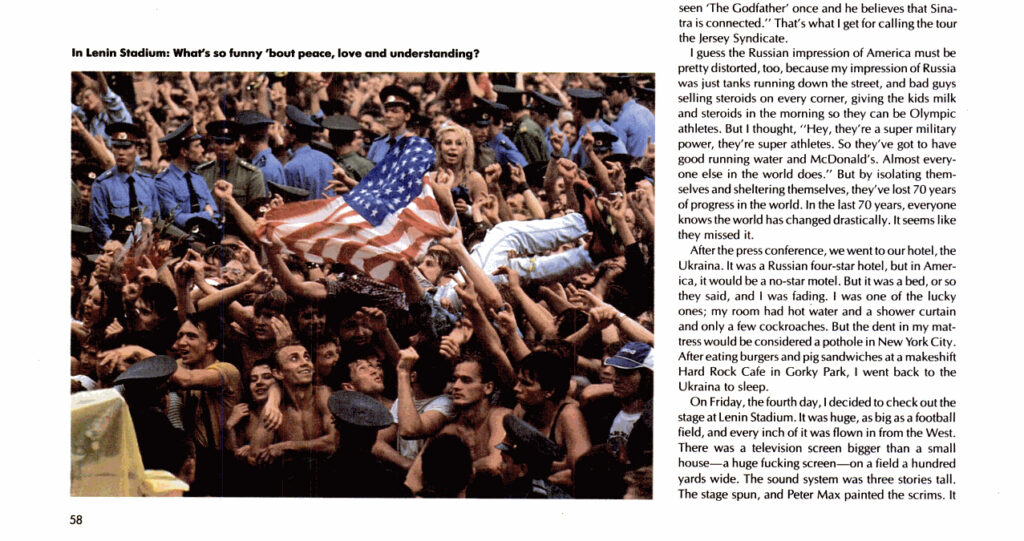
At 1:30 p.m. on Saturday, August 12, the Soviets got their first taste of New Jersey. Skid Row opened the show. Every band was there at 1:00 in the afternoon — we weren’t even going on till 10:00 that night — because of the anticipation. The head of the Soviet Peace Committee, a gray-haired guy in a sky-blue suit, made the opening announcements and lit the torch for the first time since the 1980 Olympics. Here’s this very heavy guy telling the kids in Russian, “Have a good time, enjoy this. You are the future.” Even he had opened up to the idea of exposing the kids to the West.
The Skids came out; the first thing Sebastian Bach said was, “Check this out, motherfuckers.” And I thought, “Oh no. They give us carte blanche and we give them Sebastian.” But no one did anything, there was absolutely no censorship. They played a good set and were fairly well-received for a band that had never ever been heard of. But when they went off stage, the entire stadium started this chant, “Ozzy! Ozzy! Ozzy!” And it kept building.
We were saying, “Fuck, Ozzy’s gonna steal this fucking show. This is wild, this is great.” Ozzy was right behind the stage, and I saw him perk up like a fucking 2-year-old. He was so excited. And I was so happy for him — this guy who’s been in the business 20 years, about to do the last show of his tour. He was going to go home for a while, going to take it easy.
So Oz had his hands up in the air, knowing that it was his day. But he went on to a pretty lukewarm reception. And he didn’t play bad, he played very well. Immediately, I had the whole event in perspective. I understood. For 20 years, they’d seen his picture, for 20 years they’d heard his music — from Black Sabbath to his last solo album. But he wasn’t a real person to them. He was imaginary. And in their imagination, he could have been blue and 30 feet tall. But on that stage, he was just a man. He’d been reduced to a mortal. At that moment, I understood. We weren’t just doing a rock show, we had to make an impression, one that would last. We had to make friends with these people even with the terrible language barrier and all the preconceptions.
I was in the recording truck watching the Scorpions, the only ones who had the advantage of having played in Russia before. For me, there was a nervous anticipation, knowing I had to close the show after such a killer live band. The first tour I ever did was opening for the Scorpions. But I was always real dangerous if I was your opening act, because if I found a hole I knew how to utilize it.
So there it was, right down the center of the stadium, hundreds of Soviet soldiers, arm in arm, formed a human barricade to separate the seas of people. And I saw the hole. So after the Scorpions, when the house lights went down, Bon Jovi came on, and the band hammered out “Lay Your Hands On Me,” I did Rocky Balboa in a full military outfit right down the middle of Lenin Stadium. Right down the center of those soldiers, in front of 90,000 kids. They were smiling, trying to reach at me, and the Olympic torch burned brightly over their heads. Going right down the center in a Russian uniform, that was all it took. I felt like one of them then.
I definitely think the Moscow Music Peace Festival did something for peace. The American ambassador attended and he had nothing to do with the show. Absolutely nothing. He showed up there and said, “This is something that we couldn’t have done, politicians could have never done. I can’t believe you guys pulled this off.” Because we didn’t understand where the red tape was, we just pretended it didn’t exist. “Trust us, trust us, it’ll work.” When the ambassador to America is there, you think that maybe somehow he relayed the message back to the President of the United States. And all of a sudden, in a roundabout way, the President’s aware of who Bon Jovi is. You think, Check that out. Of course, I’m pulling my own strings, because if he knew anything, he knew of this event. But you have to build it up in your own mind: Yeah, man, and I bet he’s got the last two albums, too. But it was an amazing feeling.
The trip, the event, really made me think about the freedom in my life. I learned all the words to “God Bless America.” You bet I did. There’s a lot of problems in America, mind you. But I’ve been just about everywhere and if I haven’t been there yet, I’m on the way this tour. And there’s nothing that even comes close to America. Some guys wrote a constitution 200 years ago and it still stands up today. That’s some insight, foresight. That’s pretty amazing. There’s the opportunity to do anything. Christ, that’s the basis of my entire life: You can do anything.I’ll never forget being onstage in Lenin Stadium, that guy from the Peace Committee to my left in the front row and a girl sitting on a guy’s shoulders waving a huge American flag, the politicians, the soldiers tapping their feet along with the music, and then over to my right was the fucking Olympic torch. I felt like an athlete and I felt like a politician and I felt like we were the focal point of something pretty historic. Of course, we won’t remember that the sound sucked or things like that. You try to forget all that and you make your mind believe that it was the most beautiful thing in the world. I hope it did good. And I think maybe it did.